
ShipWorks
What Is ShipWorks?
ShipWorks is desktop shipping software that connects to your Ecommerce account to pull in orders and help you print shipping labels, manage carriers, and track shipments — all from a single computer at your dealership.
Why Use ShipWorks with Ecommerce?
When you sell parts and accessories on Amazon, eBay, or your webstore through Ecommerce, every order lands in one place. ShipWorks then pulls those orders down to your shipping workstation so you can:
- Ship from one screen — No jumping between Amazon Seller Central, eBay, or other marketplaces.
- Use your own carrier accounts — Print FedEx, UPS, and USPS labels with your negotiated rates.
- Automatically send tracking back — Once you ship an order in ShipWorks, the tracking number flows back into Ecommerce, the order is marked as fulfilled, and Ecommerce forwards that tracking information to the appropriate marketplace (Amazon, eBay, etc.).
You only need one Ecommerce license purchased through ShipWorks to handle orders from all of your connected marketplaces.
Setting Up ShipWorks
Step 1: Enable ShipWorks in Ecommerce
- Log in to your Ecommerce dashboard.
- Click Settings in the top navigation bar.
- Under Module Settings, click ShipWorks.
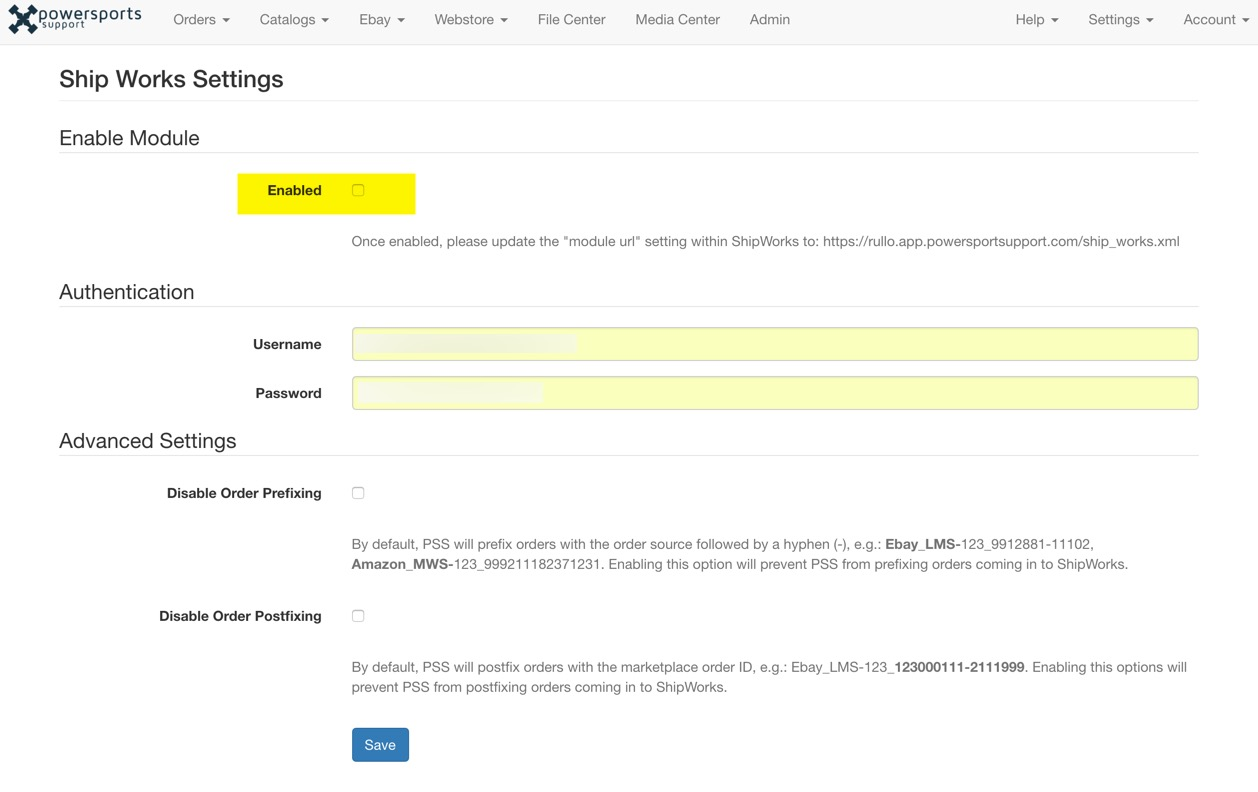
- Check the box next to Enable Module to turn on the ShipWorks integration.
Step 2: Set Your ShipWorks Username and Password
On the same ShipWorks settings page in Ecommerce:
- In the Authentication section, enter a Username of your choice.
- Enter a Password of your choice.
- Save your settings.
Important: These credentials are what ShipWorks will use to connect to Ecommerce. Write them down — you will need to enter them in ShipWorks in the next step. These are NOT your Ecommerce login credentials; they are a separate username and password just for the ShipWorks connection.
Step 3: Note Your Module URL
After enabling the module, Ecommerce displays your module URL. It follows this format:
https://yourdealership.app.powersportsupport.com/ship_works.xml
Replace yourdealership with your actual Ecommerce subdomain. Copy this URL — you will need it for ShipWorks.
Step 4: Connect ShipWorks to Ecommerce
- Open ShipWorks on your shipping computer.
- Go to Manage > Stores and click Add Store.
- Select the Generic Module store type.
- When prompted for the Module URL, paste the URL from Step 3:
https://yourdealership.app.powersportsupport.com/ship_works.xml - Enter the Username and Password you created in Step 2.
- Click Next and follow the remaining prompts to complete the store setup.
- ShipWorks will connect to Ecommerce and pull in your store information automatically.
Step 5: Set Up Your Carriers in ShipWorks
ShipWorks handles carrier setup independently from Ecommerce:
- In ShipWorks, go to Manage > Shipping Settings.
- Add your FedEx, UPS, and/or USPS accounts by entering your carrier account credentials.
- Configure your default shipping preferences (package types, label formats, etc.).
Step 6: Configure Optional Settings in Ecommerce (Advanced)
Back in Ecommerce under Settings > ShipWorks, you will find several optional settings:
Order Custom Fields
You can map up to 5 custom fields that will be sent to ShipWorks with each order. The available fields are:
| Custom Field Option | What It Sends |
|---|---|
| Marketplace Name | The source marketplace (e.g., "Amazon", "eBay") |
| Marketplace Order ID | The original order ID from the marketplace |
| Marketplace User ID | The buyer's marketplace user ID |
To configure: Choose which data you want in Custom 1 through Custom 5 dropdowns, or leave them set to "Unused."
Disable Order Prefixing
By default, Ecommerce adds a prefix to order numbers showing the source marketplace, for example:
Ebay_LMS-12345Amazon_MWS-12345
If you check Disable Order Prefixing, orders will appear in ShipWorks without that marketplace prefix.
Disable Order Postfixing
By default, Ecommerce appends the marketplace order ID to the end of order numbers, for example:
Ebay_LMS-12345_123000111-2111999
If you check Disable Order Postfixing, orders will appear without that trailing marketplace order ID.
Tip: Most dealerships leave prefixing enabled so they can quickly tell which marketplace an order came from when looking at the ShipWorks order list.
How It Works
The Complete Order Flow
Customer places order on Amazon/eBay/Webstore
                        |
                        v
        Order arrives in Ecommerce (your central hub)
                        |
                        v
     ShipWorks polls Ecommerce and downloads new orders
       (up to 10 orders at a time, by modified date)
                        |
                        v
    You open ShipWorks on your shipping computer,
      select orders, and print shipping labels
                        |
                        v
     ShipWorks sends tracking number back to Ecommerce
     and marks the order as "Fulfilled"
                        |
                        v
      Ecommerce sends the tracking number to the
      appropriate marketplace (Amazon, eBay, etc.)
                        |
                        v
       Customer receives shipping notification
What Data Goes to ShipWorks?
When ShipWorks downloads an order from Ecommerce, it receives:
- Order number (with optional marketplace prefix/postfix)
- Order date and last modified date
- Order status
- Billing address — Full name, street address (up to 3 lines), city, state, zip, country, phone, email
- Shipping address — Full name, street address (up to 3 lines), city, state, zip, country, email
- Shipping method — The shipping method selected at checkout (or "Default" if none was specified)
- Order items — SKU, product name, quantity, unit price, item description, and lead time
- Order totals — Item total, tax, and shipping/handling
- Payment method — How the customer paid
- Order notes — Any notes attached to the order (marked as internal/private)
- Custom fields — Up to 5 configurable fields (marketplace name, order ID, user ID)
What Comes Back from ShipWorks?
When you ship an order in ShipWorks, it sends two things back to Ecommerce:
- Tracking number — Saved to the order record in Ecommerce.
- Order status update — The order is automatically marked as Fulfilled in Ecommerce.
ShipWorks can also update order statuses independently (without a tracking number) if you change the status of an order within ShipWorks.
How Often Does ShipWorks Check for Orders?
ShipWorks uses a "ByModifiedTime" download strategy. This means:
- ShipWorks periodically polls Ecommerce for new or recently modified orders.
- Orders that have not yet been downloaded, or that have been modified since the last download, will be included.
- Each download retrieves up to 10 orders at a time.
- Once an order is downloaded, it is flagged in Ecommerce so it is not sent again (unless it is modified).
You can also manually trigger a download in ShipWorks by clicking the Download button.
Frequently Asked Questions
Q: Do I need a separate ShipWorks license for each marketplace?
No. You need only one Ecommerce license purchased through ShipWorks. That single license covers orders from all marketplaces connected to your Ecommerce account (Amazon, eBay, webstore, etc.).
Q: Where do I find the ShipWorks settings in Ecommerce?
Log in to Ecommerce, click Settings in the top navigation, then look under Module Settings and click ShipWorks.
Q: Can I use ShipWorks on multiple computers?
ShipWorks is designed to run on a designated shipping computer. Consult ShipWorks documentation for multi-workstation licensing details.
Q: What happens if I change my ShipWorks username or password in Ecommerce?
ShipWorks will no longer be able to connect until you update the credentials in ShipWorks as well. Go to Manage > Stores in ShipWorks, edit your Ecommerce store, and enter the new username and password.
Q: Why are my order numbers showing marketplace names like "Ebay_LMS-" or "Amazon_MWS-"?
This is the default order prefixing behavior. Ecommerce adds the marketplace source name to help you identify where each order came from. If you prefer clean order numbers, you can disable this under Settings > ShipWorks > Disable Order Prefixing in Ecommerce.
Q: How quickly does tracking information get sent back to the marketplace?
Once you ship in ShipWorks, the tracking number is sent back to Ecommerce almost immediately. Ecommerce then forwards it to the appropriate marketplace during its next sync cycle, which typically happens within minutes.
Q: Do I set up FedEx/UPS/USPS in Ecommerce or in ShipWorks?
Carrier accounts are configured entirely within ShipWorks. Ecommerce does not manage carrier accounts or shipping rates. Ecommerce only handles the order data and tracking numbers.
Q: Can I use ShipWorks and ShippingEasy at the same time?
While Ecommerce supports both ShipWorks and ShippingEasy as module options, it is recommended to use only one shipping solution at a time to avoid duplicate shipments or conflicting tracking updates.
Q: What order statuses does ShipWorks see?
ShipWorks pulls all of the order statuses configured in your Ecommerce account. When you ship an order, ShipWorks sets the status to Fulfilled automatically.
Q: How many orders can ShipWorks download at once?
Each download retrieves up to 10 orders at a time. If you have more pending orders, ShipWorks will make multiple requests to retrieve them all.
Troubleshooting
| Problem | Likely Cause | Solution |
|---|---|---|
| ShipWorks cannot connect to Ecommerce | Incorrect module URL | Verify the URL is exactly https://yourdealership.app.powersportsupport.com/ship_works.xml (replace yourdealership with your actual subdomain). |
| "Incorrect username" or "Incorrect password" error | Credentials mismatch | Confirm the username and password in ShipWorks match exactly what you entered in Ecommerce under Settings > ShipWorks > Authentication. Credentials are case-sensitive. |
| "ShipWorks is not enabled for this account" error | Module not turned on | Go to Ecommerce Settings > ShipWorks and make sure the Enable Module checkbox is checked. |
| No orders appearing in ShipWorks | No new/undownloaded orders | Check Ecommerce to confirm there are orders that have not yet been downloaded. Orders must have a customer name to be eligible for download. |
| Orders showing but missing shipping address | Incomplete order data | Verify the order in Ecommerce has a valid shipping address. Orders without shipping information will show incomplete data in ShipWorks. |
| Tracking number not updating in Ecommerce | ShipWorks not sending update | After shipping in ShipWorks, verify the order status changed. If not, try manually uploading shipment data from ShipWorks. Check your internet connection. |
| Duplicate orders in ShipWorks | Order was modified after download | This is expected behavior — modified orders are re-sent. ShipWorks should match them by order number and update rather than duplicate. If duplicates persist, check the prefix/postfix settings. |
| Order numbers look confusing | Prefix/postfix enabled | If you find order numbers like Amazon_MWS-123_999211182371231 hard to work with, disable prefixing and/or postfixing in Ecommerce under Settings > ShipWorks. |
| Connection timeout | Network or server issue | Verify your internet connection. Ensure Ecommerce is accessible by visiting your dashboard URL in a browser. If Ecommerce is down, wait and try again. |